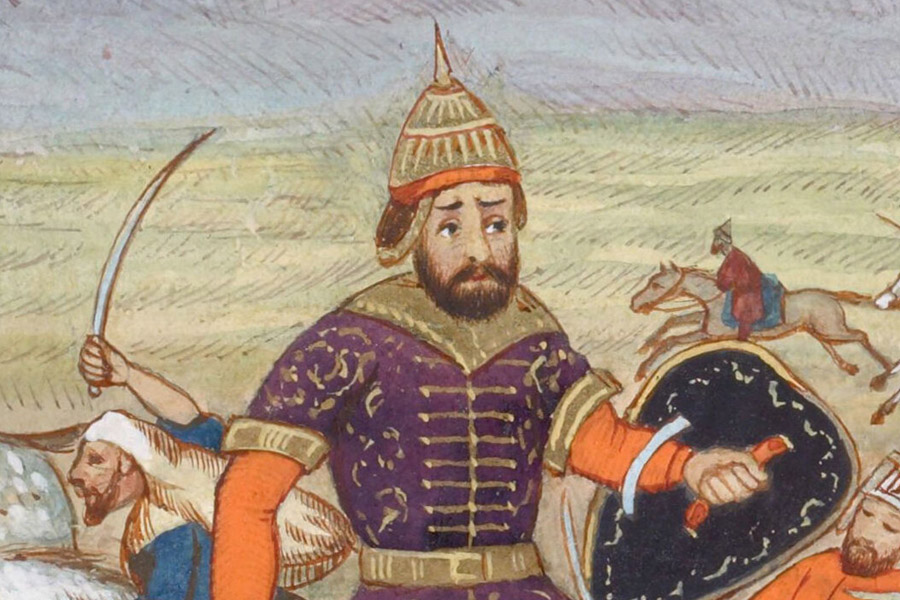
Basic Information
| Field | Detail |
|---|---|
| Name | Rostam Farrokhzad |
| Native name | رستم فرخزاد |
| Also known as | Rostam b. Farroḵ-Hormozd |
| House | Ispahbudhan (Espahbodān), one of the seven great Parthian clans |
| Rank and office | Spahbed of the northwestern kust of Adurbadagan; commander in chief during the 630s |
| Active years | Late 590s or early 610s to 636 CE |
| Born | Late 6th or early 7th century CE, associated with Adurbadagan, Ray, Hamadan, or Armenia |
| Died | 19 November 636 CE, at the Battle of al-Qadisiyyah |
| Parents | Father: Farrukh Hormizd |
| Siblings | Brother: Farrukhzad |
| Notable events | Capture of Ctesiphon in 631; restoration of Queen Boran; installation of Yazdegerd III in 632; command at al-Qadisiyyah in 636 |
| Known for | Leadership during the civil wars and Arab invasions, strategic caution, and emblematic death marking the empire’s collapse |
| Cultural footprint | Historical chronicles and heroic portrayal in Persian literature distinct from the legendary Rostam son of Zal |
Origins and the House of Ispahbudhan
The Ispahbudhan, one of the seven elite Parthian clans absorbed into the Sasanian state, produced Rostam Farrokhzad. The family had legendary Arsacid ancestry to Kayanian folklore. Over generations, their bloodline joined the Sasanian royal house. Rostam’s great-grandfather, Shapur, and father, Farrukh Hormizd, were first cousins of Khosrow I and II.
Rostam grew up on the empire’s northern marches in this prestige-obligation junction. Adurbadagan was his nominal command, but his family had holdings and power from Azerbaijan to Khorasan in northern Iran. A world where rank was land and land was armies, he inherited a legacy and a burden.
Rise Through Turmoil 627-632
The late 620s whirled. In 628, Khosrow II fell, allowing rival factions to emerge after the disastrous war with Byzantium. Rostam and his father supported the Pahlav aristocracy against court rivals. After Farrukh Hormizd sought the throne and marriage, Queen Azarmidokht slew him in 630–631. Rostam retorted steelily. He took Ctesiphon, deposed the queen, and blinded her to revenge his father. He returned Queen Boran to the throne in June 631 and enthroned the youthful Yazdegerd III in 632 with leading magnates after more palace bloodletting.
In these years, Rostam functioned as kingmaker and shield bearer. He did not seize the diadem. Instead he governed from the saddle, coaxing order from chaos, mindful that the empire’s frontiers were creaking under new pressures from the south.
The Commander at al-Qadisiyyah 636
Arab troops invaded Mesopotamia in 634–636. Calling Rostam west. He reinforced the Euphrates and Ctesiphon approaches, brought elephants into battle, and tried to dominate the fight. Attrition and staged deployments were his operational doctrine. His delay. He bargained. He absorbed shock and drained momentum to slow the intruders.
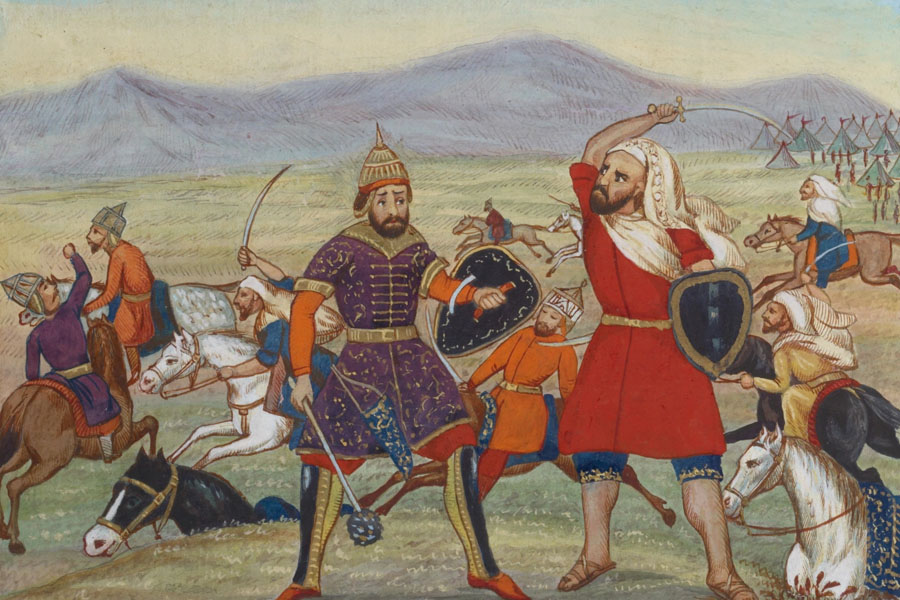
He led the largest Sasanian host of the time, tens of thousands with elite cataphracts and war elephants, at al-Qadisiyyah in November 636. Four-day fight turned crucible. A sandstorm ripped through lines like a dust curtain. Countermeasures eliminated vital elephants on day one. Rostam fell in the chaos on the last day. He may have been beheaded, according to legend. Trampling amid chaos is another description. His death, whatever it occurred, weakened Iraqi Sasanian resistance. The Ctesiphon road was open.
Family Network and Political Leverage
Rostam’s life was defined as much by bloodlines as by battle lines. His core family was small, tightly documented, and politically potent.
The Ispahbudhan Family Core
| Relative | Role and significance | Key dates and notes |
|---|---|---|
| Farrukh Hormizd (father) | Spahbed of Adurbadagan, Pahlav faction leader, first cousin of Khosrow II | Overthrew Khosrow II in 628; bid for throne 630-631; slain by Queen Azarmidokht |
| Rostam Farrokhzad | Avenged father, captured Ctesiphon, restored Boran, installed Yazdegerd III, commanded at al-Qadisiyyah | 631 capture of Ctesiphon; died 19 Nov 636 |
| Farrukhzad (brother) | High court status under Khosrow II, successor spahbed after 636, defender of Madāʾen and Jalula, later ruler in Tabaristan | Founded Bavand dynasty 651-665; son Surkhab I continued the line |
No historical reports mention Rostam’s wives or children. Chronicles focus on his paternal line and state service, obscuring his private life. Later epic literature occasionally links him to Rostam son of Zal, but that’s myth, not history.
Power, Land, and Revenues
Rostam’s command was not sheer charisma. In northern Iran, the Ispahbudhan had vast estates, tax rights, and levies. As spahbed of Adurbadagan, he could summon local magnates, mobilize provincial garrisons, and generate revenue to transport cavalry, elephants, and supply trains. His house served as treasury and mustering yard in a feudal empire. These riches helped him stabilize the capital in 631 and build the large field army in 636.
Key Figures Around Rostam
- Yazdegerd III: Child king installed in 632 with Rostam’s backing, last Sasanian monarch.
- Boran: Queen restored by Rostam in 631 during an attempt to staunch civil strife.
- Azarmidokht: Queen whose court ordered the murder of Farrukh Hormizd, precipitating Rostam’s seizure of Ctesiphon.
- Saʿd ibn Abi Waqqas: Arab commander opposing the Sasanians at al-Qadisiyyah.
- Shahrbaraz: Rival general whose short rule in 630 fed the vortex of the civil wars.
- Heraclius: Byzantine emperor whose war with Khosrow II set the stage for Sasanian exhaustion by the 630s.
Memory, Myth, and Modern Echoes
Rostam’s visage is fact and symbol. Chronicles describe the general who negotiated time, assessed omens, and shifted forces. Literature portrays him as a brave warrior in a darker age, distinct from Zabol’s epic hero. In communal memory, he is the last Pahlavan, a sea wall against the rising tide. His name is extensively used in Iranian culture to teach loss and endurance. His final letter to his brother and al-Qadisiyyah’s dusty thunder are recounted in posts and essays The guy fades, the symbol lives.
Extended Timeline
| Year | Event |
|---|---|
| Late 590s to early 610s | Birth within the Ispahbudhan house, linked to Adurbadagan and nearby regions |
| 602-628 | Family navigates the Byzantine-Sasanian War, aligning within the Pahlav aristocracy |
| 627-628 | Participation in the overthrow of Khosrow II |
| 630-631 | Farrukh Hormizd murdered after pursuing the throne; Rostam marches on Ctesiphon |
| June 631 | Rostam captures Ctesiphon, avenges his father, restores Queen Boran |
| 632 | Rostam and allied magnates install Yazdegerd III as king |
| 634-636 | Rostam fortifies the western front, negotiates, and assembles a large field army |
| 19 November 636 | Death at al-Qadisiyyah during a four day battle that seals the fate of Sasanian Iraq |
| 636-651 | Brother Farrukhzad continues resistance, then rules in Tabaristan; Bavandid line begins |
Numbers and Field Realities at al-Qadisiyyah
- Days of battle: 4
- Force size: Tens of thousands under Rostam’s command, including elite heavy cavalry and war elephants
- Strategic approach: Delay, negotiation, and attrition, seeking to avoid a single irreversible clash
- Outcome: Collapse of the Sasanian position in Iraq following Rostam’s death
FAQ
Was Rostam Farrokhzad related to the Sasanian royal family?
Yes, through the Ispahbudhan line his forebears were close kin to Khosrow I and Khosrow II, placing him within the outer circle of the royal house.
Did Rostam ever claim the throne himself?
No, he leveraged his power as kingmaker and spahbed, installing and supporting monarchs rather than taking the diadem.
What happened to his family after his death?
His brother Farrukhzad took up command, defended the heartland, and later founded the Bavandid dynasty in Tabaristan.
Did Rostam have children?
No historical record names any spouse or child of Rostam; later epic traditions that claim descendants belong to mythic cycles.
How large was his army at al-Qadisiyyah?
It numbered in the tens of thousands, with heavy cavalry and elephants forming the striking core.
Why did Rostam delay battle at al-Qadisiyyah?
He aimed to stretch the conflict, sap enemy momentum, and fight on favorable terms rather than risk a single decisive engagement.
Is he the same figure as the legendary Rostam of the epics?
No, the historical Rostam Farrokhzad is a different person, though later literature sometimes casts him in a heroic mold.
What single event most defined his legacy?
His death on 19 November 636 at al-Qadisiyyah, which became a symbol of the Sasanian fall and the end of an era.