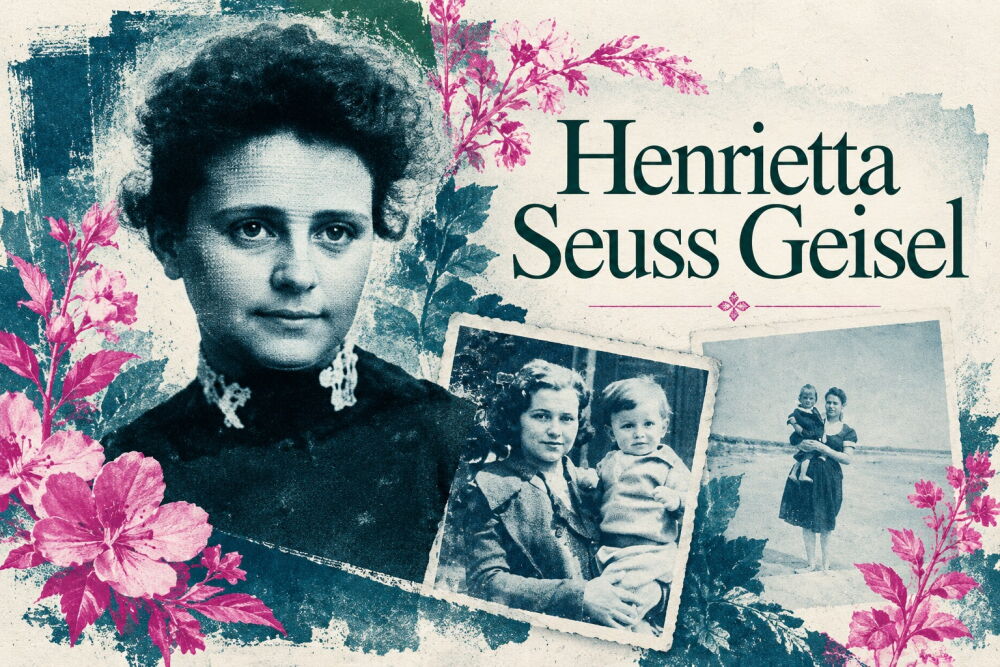
The Mother Behind Seuss
The name Seuss traveled much farther than Henrietta Augusta Seuss could have known. It was her maiden name before it became part of her son’s literary identity, and it connected the author remembered as Dr. Seuss to a Springfield family home. I find that connection a useful way into her story: a familiar name on a book cover began as a mother’s family name.
Henrietta Seuss Geisel was born in Springfield, Massachusetts, on May 13, 1878. She died there on March 8, 1931, aged 52. Her son Theodor had just turned 27. His first famous children’s book, And to Think That I Saw It on Mulberry Street, would not appear until 1937, six years after her death.
She therefore never saw the long procession of characters and titles that later made his work a fixture of childhood. Her own life belongs to an earlier family story, shaped by marriage, children, bereavement, and the German-American brewing community of Springfield.
From the Seuss Family to the Geisel Household
Henrietta’s parents are identified as George J. Seuss and Margaretha Katherine Greim, whose name also appears as Margaret Katherine. Their reported ages at her birth were 21 and 16. Those details establish a generational starting point without providing a full portrait of their household.
On February 27, 1902, Henrietta married Theodor Robert Geisel in Manhattan. He had been born in 1879 and came from a Springfield brewing family. Their son would receive his father’s first name and his mother’s maiden name, a combination that carried both branches forward.
I would not assume that the Manhattan wedding meant the couple permanently relocated there. Their family history is firmly associated with Springfield, where their children grew up and where Henrietta’s life ended.
Theodor Robert worked in the family brewery’s management. Prohibition later damaged the business, as it did many brewing enterprises. The available account does not supply a balance sheet or Henrietta’s personal finances, so that economic context should not be converted into an invented estimate of the family’s wealth.
Three Children and One Early Loss
Henrietta and Theodor Robert had three children. Their oldest daughter was Margaretha, affectionately called Marnie. Her name also appears in variants including Marguerita Christina and Margaretha Christine, and her birth year is given as either 1902 or 1903.
Their son, Theodor Seuss Geisel, was born on March 2, 1904. A second daughter, Henrietta Bertha, followed in 1906. The youngest child died in 1907 after a cough developed into pneumonia.
The infant’s funeral took place at home. Marnie, then in first grade, tried to comfort her mother and never forgot her younger sister. I find those details more affecting than an embellished scene would be. They show a child witnessing her mother’s sorrow without requiring invented dialogue or imagined gestures.
| Child | Dates or approximate dates | Family detail |
|---|---|---|
| Margaretha, called Marnie | Born about 1902 or 1903; died 1945 | Older daughter and later mother of Peggy |
| Theodor Seuss Geisel | March 2, 1904, to September 24, 1991 | Author and illustrator known as Dr. Seuss |
| Henrietta Bertha Geisel | 1906 to 1907 | Died in infancy from pneumonia |
The uncertainty around Marnie’s birth year should remain visible. Choosing one version simply for a cleaner table would make the family chronology appear more settled than it is.
Wordplay Before the Books
Henrietta is remembered as encouraging rhyming and wordplay at home. That is a modest but meaningful connection to her son’s later work. I would describe it as an influence rather than claim that every feature of his style can be traced to her.
Theodor adopted Seuss as a pen name and later added Dr. His career eventually encompassed more than 60 books, political cartoons, and work on Army training films during World War II. The Cat in the Hat, How the Grinch Stole Christmas!, Green Eggs and Ham, and Horton Hears a Who! belong to that later career.
Henrietta did not live to see any of those titles. The distinction matters because a retrospective account can easily make a parent seem present throughout an adult child’s achievements. Her role was earlier: she helped shape the home in which Ted first encountered language, rhythm, and play.
No separate occupation or published artistic career is established for her. That absence does not diminish the family role that is documented, but it does limit what can responsibly be claimed about her work outside the household.
Marnie and the Next Generation
Marnie married Lloyd Dahmen and moved to Jamestown, New York. On November 1, 1927, she gave birth to a daughter. The baby had been expected to receive the name Theodor if a boy; instead she was named Margaretha and became known as Peggy.
Marnie and Lloyd divorced about a year later. Marnie died in 1945. These details help trace the family beyond the famous son, although a complete biography of Marnie is not available here.
Peggy’s birth made Henrietta a grandmother in 1927, roughly three years before her death. Her son Ted had no children. I find it helpful to distinguish those branches because the broad phrase “the Dr. Seuss family” can obscure the lives of his sister and niece.
A Springfield Timeline
| Date | Milestone |
|---|---|
| May 13, 1878 | Henrietta Augusta Seuss was born |
| February 27, 1902 | Marriage to Theodor Robert Geisel |
| About 1902 or 1903 | Marnie’s birth |
| March 2, 1904 | Ted’s birth in Springfield |
| 1906 | Youngest daughter Henrietta was born |
| 1907 | Infant daughter’s death |
| November 1, 1927 | Granddaughter Peggy was born |
| March 8, 1931 | Henrietta died at 52 |
| 1937 | Mulberry Street was published |
| 1968 | Theodor Robert Geisel died |
FAQ
What was Henrietta Seuss Geisel’s full name?
She was born Henrietta Augusta Seuss and became Henrietta Geisel after marriage. Henrietta Seuss Geisel preserves both family names.
She was his mother. His full name was Theodor Seuss Geisel, and his pen name drew on her maiden name.
Did she see her son’s famous children’s books?
No. She died in 1931, before the 1937 publication of And to Think That I Saw It on Mulberry Street and long before his later best-known titles.
How many children did she have?
She had three children: Marnie, Theodor, and Henrietta Bertha. The youngest died in infancy in 1907.
Where did Henrietta live and die?
Her life is principally associated with Springfield, Massachusetts, where she was born, died, and was buried. Her marriage ceremony took place in Manhattan.